Comparison
Air Purifier vs Indoor Plants: Which Cleans Air Better?
One of them would need a small forest in your living room to do the job. Here's which.
Draws on the peer-reviewed studies listed below.
What's in this list
- 01What each one is actually promising
- 02The NASA clean air study, read all the way through
- 03Air purifier vs indoor plants on raw cleaning power
- 04Cost, upkeep, and the parts nobody puts on the label
| Dimension | HEPA air purifier | Air-purifying indoor plants |
|---|---|---|
| Removing fine particles (dust, smoke, pollen) | Strong. HEPA media captures at least 99.97% of 0.3-micron particles, and field trials show real homes drop indoor PM2.5 by roughly 30 to 65% [1][4][5]. | Negligible in practice. Leaves do little for airborne particulate matter, and chamber gains vanish at room scale [2]. |
| Removing VOCs (off-gassing, solvents) | Plain HEPA does not touch gases. Models with activated carbon help somewhat, but VOC control is not their strong suit. | Measurable in sealed chambers, irrelevant in real rooms. You would need 10 to 1,000 plants per square meter to match normal ventilation [2]. |
| Upfront cost | Higher single purchase, roughly 80 to 250 euros for a decent unit sized to one room. | Low per plant, but the number needed for real air cleaning makes the honest total enormous. |
| Ongoing effort | Swap filters on schedule, wipe the intake, keep it powered. Mostly passive. | Water, light, repotting, pest control. Pleasant if you enjoy it, constant either way. |
| Noise, space, looks | Takes floor space and hums, from a whisper on low to a drone on high. | Silent, warm, alive. Wins on aesthetics and mood without contest. |
The verdict
For cleaner air, buy the HEPA purifier. It is the only one of the two that measurably lowers particulate matter at the scale of a real room. Keep plants for how they make the space feel, not for what they do to the air.
- HEPA air purifier suits
- Anyone with allergies, pets, wildfire smoke, a smoker in the house, or a gas stove who wants a measurable drop in fine particles.
- Air-purifying indoor plants suits
- Anyone who wants a calmer, greener room and treats any air benefit as a rounding error rather than the reason to buy.
A pothos on the windowsill will not save your lungs. That is the uncomfortable finding behind a decade of headlines about houseplants scrubbing the air, and it traces back to a 1989 NASA report that almost nobody reads past the first paragraph.
The question is fair. You want cleaner air at home. You can buy a machine that hums in the corner, or you can fill the room with greenery that also looks good on a shelf. Both promise the same thing. Only one delivers it at the scale your actual rooms require, and the gap is wider than the marketing lets on.
What each one is actually promising
The purifier makes a narrow, testable claim: pull air through a filter, trap the particles, send back cleaner air. A HEPA filter is rated to catch at least 99.97% of particles at 0.3 microns, the size hardest to capture. Bigger and smaller particles are caught even more reliably [1]. That covers most of what floats around a home: dust, pollen, pet dander, smoke, the fine particulate matter tied to respiratory and cardiovascular strain.
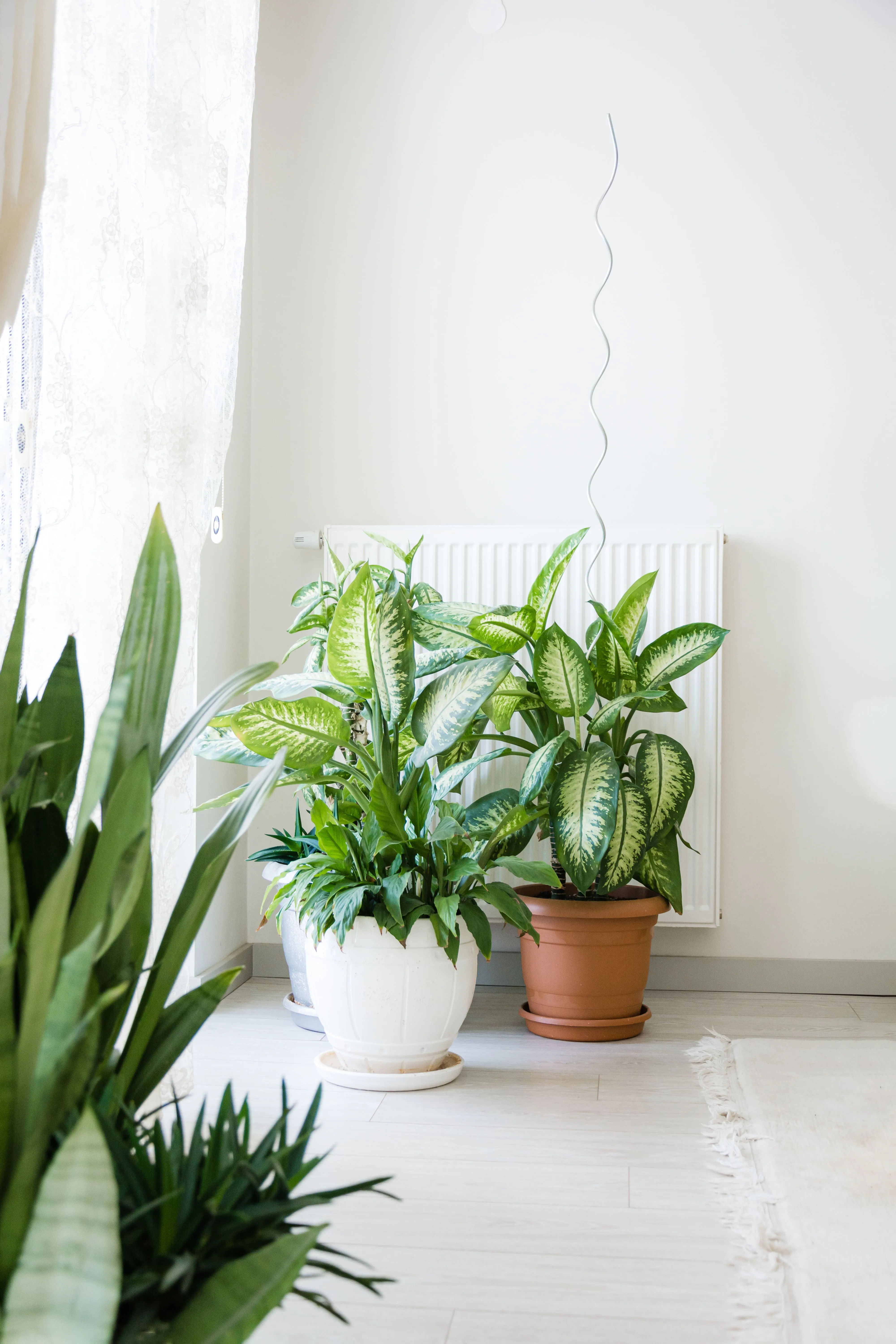
Plants promise something fuzzier. The pitch, repeated by garden centers and lifestyle blogs for thirty years, is that certain species pull toxins out of the air and hand you a cleaner room as a bonus of looking nice. “Air-purifying” has become a plant-shop label, slapped on pothos, snake plants, peace lilies, and the rest of the usual cast.
The two claims sound parallel. They aren’t. One describes a measured removal rate for particulate matter. The other rests almost entirely on a single study, run under conditions that look nothing like your living room.
The NASA clean air study, read all the way through

In 1989, NASA researcher B.C. Wolverton published “Interior Landscape Plants for Indoor Air Pollution Abatement.” The goal was space habitats: sealed cabins where synthetic materials off-gas VOCs like formaldehyde and benzene with no fresh air to dilute them. He put houseplants in small sealed chambers, injected a VOC, and tracked how fast it dropped. Plants did remove VOCs. Snake plants and peace lilies did well. The study was real, and the results held up on their own terms.
The catch is the chamber. It was about the size of an armchair. Your rooms are not sealed, and they are far bigger. A 2020 review in the Journal of Exposure Science and Environmental Epidemiology took 196 experimental results from a dozen of these plant studies and converted each into a clean air delivery rate, or CADR, the same metric used to rate purifiers. The median single-plant CADR came out to about 0.023 cubic meters per hour [2].
That number is tiny. The everyday air exchange in a normal building, through gaps and open windows and ventilation, dilutes VOCs far faster than any potted plant can absorb them. The NASA finding was never wrong. It just was never about your apartment.
Air purifier vs indoor plants on raw cleaning power
Here the numbers stop being close. To match the VOC removal that ordinary ventilation already gives you in a typical room, the review calculated you would need somewhere between 10 and 1,000 plants per square meter of floor [2]. Picture that density across your living room. It is not a decorating scheme, it is a greenhouse, and even then you are only matching a cracked window.
The purifier plays a different game. Move past the lab spec and into occupied homes. A randomized controlled trial in Ulaanbaatar gave HEPA cleaners to pregnant women in a heavily polluted city and measured a 29% drop in indoor PM2.5, rising to 40% when the filters were fresh [4]. A randomized trial among children with asthma found sleeping-area PM2.5 fell by around 60% in HEPA homes versus roughly 15% in controls [5]. A broader review of household interventions concluded that HEPA purifiers meaningfully cut indoor fine particles and even nudged cardiopulmonary health markers in the right direction [3].
One approach shows up in controlled trials with double-digit reductions. The other needs a forest to equal an open window.
Cost, upkeep, and the parts nobody puts on the label
On a single price tag, plants win. A pothos costs a few euros, a purifier eighty or more. But you are not comparing one plant to one machine. You are comparing air cleaning to air cleaning, and at the density real removal would demand, the plant total balloons past any purifier while eating your floor space.
Running costs cut the other way from how they first look. A purifier wants filter swaps once or twice a year and a bit of electricity. Set a reminder and it mostly runs itself. Plants want water on a rhythm, the right light, the odd repotting, and a response when pests show up. That upkeep is a pleasure if you like tending green things and a chore if you forget.
Then the sensory column, where the ranking flips. A purifier takes up floor space and makes noise, a soft whisper on low and a real drone on high. Plants are silent, and they change how a room feels in a way no appliance manages. If mood and warmth are what you are buying, plants are the better purchase, full stop. They just are not buying you cleaner air.
So the honest split: if the goal is measurably cleaner air, the HEPA air purifier is the pick, and it is not close. It lowers fine particulate matter in real rooms, it is backed by controlled trials rather than one sealed-chamber study, and it asks little of you beyond a filter change.
That does not make plants pointless. They are quiet, they lift a room, and there is decent evidence that living greenery does something good for how people feel in a space. Keep them for that. Water the pothos because you like the pothos.
Just run the purifier for the air.
References
- (2024). What is a HEPA filter?. US EPA, Indoor Air Quality. https://www.epa.gov/indoor-air-quality-iaq/what-hepa-filter
- (2020). Potted plants do not improve indoor air quality: a review and analysis of reported VOC removal efficiencies. Journal of Exposure Science & Environmental Epidemiology. https://doi.org/10.1038/s41370-019-0175-9
- (2020). Individual- and Household-Level Interventions to Reduce Air Pollution Exposures and Health Risks: a Review of the Recent Literature. Current Environmental Health Reports. https://www.ncbi.nlm.nih.gov/pmc/articles/PMC7749091/
- (2018). The effect of portable HEPA filter air cleaners on indoor PM2.5 concentrations and second hand tobacco smoke exposure among pregnant women in Ulaanbaatar, Mongolia: The UGAAR randomized controlled trial. Science of the Total Environment. https://doi.org/10.1016/j.scitotenv.2017.09.291
- (2021). Effectiveness of portable HEPA air cleaners on reducing indoor PM2.5 and NH3 in an agricultural cohort of children with asthma: A randomized intervention trial. Indoor Air. https://doi.org/10.1111/ina.12760
The fire's still going.
Stoke another read →