Questions answered
How Often Should You Feed a Cat Per Day? A Clear Answer
One recent study fed cats a single daily meal and found the leaner, fuller result nobody expected.
Draws on the feline feeding studies listed below.

A kitten and a fifteen-year-old cat sit at the same bowl, and the internet tells both owners the same thing: two meals a day, done. That advice is fine for plenty of adult cats. It is wrong for the kitten, shaky for the senior, and it skips the question that actually keeps cats lean.
How often should you feed a cat per day matters less than most owners think. What goes in each bowl matters more. And there is a twist buried in the research on meal timing that runs against the small-and-frequent habit most of us grew up repeating. Start with the basics, and the twist makes sense by the end.
How often should you feed a cat per day?
For a healthy adult cat, two meals a day about twelve hours apart is the routine most vets settle on, and it fits a working household. Morning and evening covers it.
That is a starting point, not a rule from the cat gods. Kittens burn energy far faster for their size and cannot hold much food at once, so they eat three to four times a day. Some adult cats do fine on one daily meal. Others graze in tiny amounts all day. The count that suits your cat comes down to age, weight, health, and honestly your schedule.
Here is what holds steady through all of it: total daily calories are what govern whether a cat stays trim. Splitting the same amount into three bowls instead of two does not make it more food. It just changes the rhythm.
How many times a day should a kitten eat?
Kittens run hot. They build muscle and bone at a pace that demands a lot of energy per pound, and their stomachs are tiny, so they cannot take it all in one sitting. Three to four meals a day keeps a steady supply coming without overwhelming that small belly.
Very young, newly weaned kittens eat even more often. As they grow, the count drops. Many kittens go from four meals to three around two to three months, then ease toward the adult routine of two meals as they near their first birthday.
Kitten feeding differs from adult feeding for a physical reason, not an arbitrary one. Studies of feline feeding tie the higher frequency to growth and higher energy needs, and that is part of why growing cats get handled differently from mature ones [1]. Larger breeds can keep growing past a year and may stay on a growth diet longer, so a vet check around the switch helps you time it.
Is free feeding or scheduled meals better for a cat?

This is the real fork in the road, and the honest answer leans one way.
Scheduled meals mean you decide how much goes in the bowl and when. That control is the single most useful tool for keeping an indoor cat at a healthy weight, because you can measure the day’s food and stop. Free feeding, leaving a full bowl out around the clock, hands that decision to the cat. Some cats self-regulate. Many, especially neutered indoor cats with modest activity, just eat what is there.
There is a real case for free access in specific situations. Newly weaned kittens with fast metabolisms often benefit from food between nursing. Multi-cat homes sometimes lean on it for practicality. And meal timing interacts with activity in ways still being studied: cats fed more often tend to move around more in anticipation of food [2].
If you do leave food out, the workaround is portion control by another name. Measure the full daily amount in the morning and let that be the ceiling, rather than refilling whenever the bowl looks low. You keep the free-feeding convenience without handing your cat an open tab.
Does controlling portions actually prevent cats from getting fat?
Cat obesity is common, and it is mostly a story of energy in versus energy out tipping the wrong way over months of small overfeeding. Portion control is how you keep your thumb on the energy-in side.
Managing weight in overweight cats relies on feeding a set, restricted amount rather than free access, and studies that follow cats through weight-loss programs are built around that controlled ration [3]. The same logic runs in reverse for prevention. Cap the daily amount at what the cat actually needs, and you remove the slow creep that leaves you with a heavier cat a year later.
Measuring beats eyeballing. A scoop that looks reasonable can carry far more calories than a cat this size needs, and treats stack on top. Keep treats to a small slice of the daily total, weigh or measure the main ration, and you do more for weight than fussing over whether it is two meals or three.
An automatic feeder can help, dispensing a fixed portion on a timer so the amount stays consistent even when you are not home to serve it.
How much should each meal be?
There is no universal gram count, because the right amount is a daily calorie target split across however many meals you feed. Feed twice, and each meal is half the day’s ration. Feed three times, each is a third of the same total.
The daily target itself hinges on the cat: body weight, age, activity, and whether it is neutered, since neutering lowers energy needs and raises appetite. The feeding guide printed on the food gives a reasonable opening estimate for your cat’s weight. Treat it as a hypothesis, not a verdict.
The real feedback comes from your cat’s body over a few weeks. If it is drifting heavier, the portion is too big whatever the label says. If ribs are getting sharp, it is too small. A vet can help you pin down a starting number and a healthy body condition to aim for, then you adjust the portion, not the meal count, to hit it.
Does feeding wet or dry food change how often I feed?
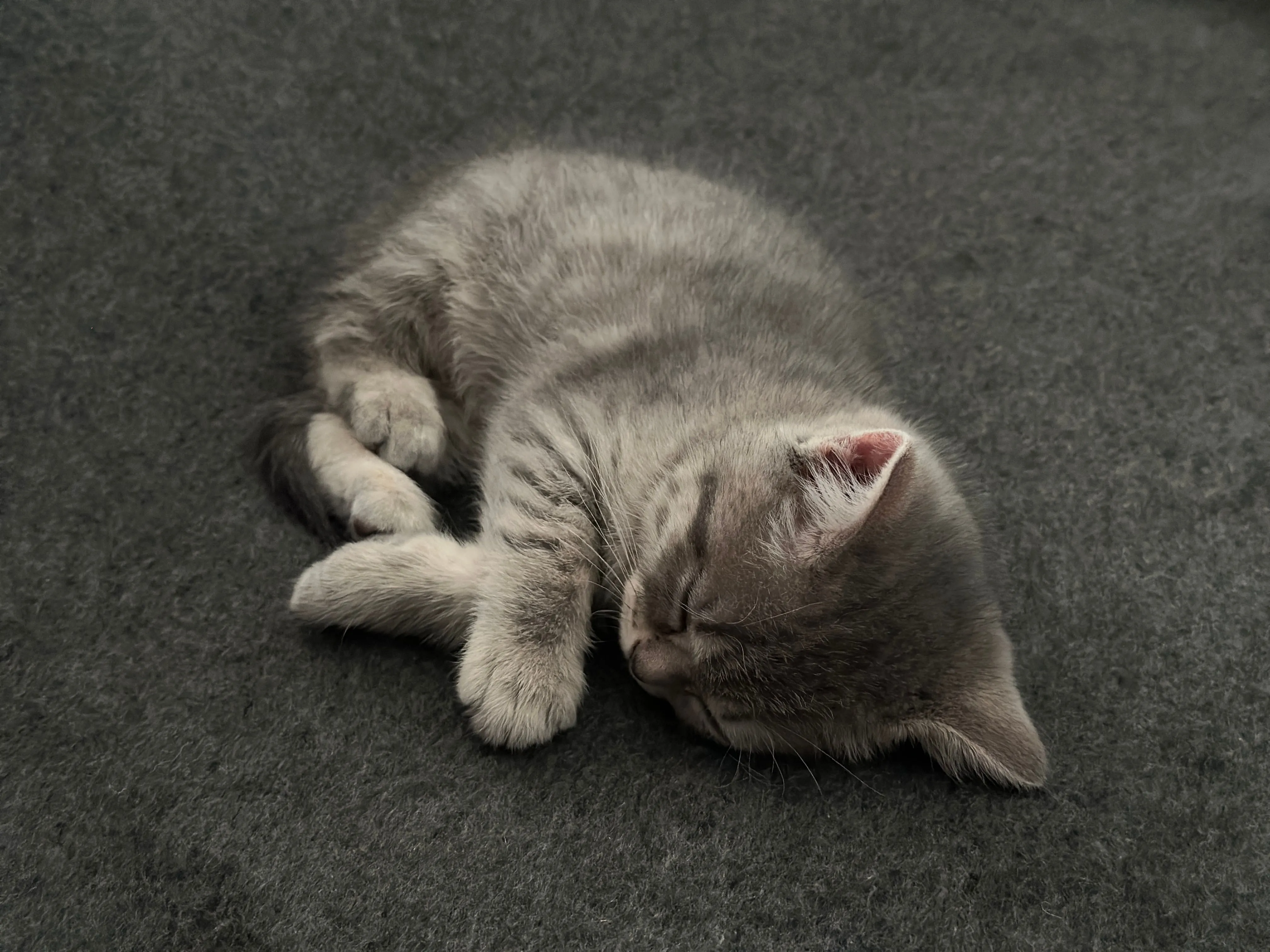
Wet versus dry mostly changes the size and character of the portion, not how many times you fill the bowl. A cat eating wet food, dry food, or both can run on the same two-meal routine as any other.
The differences are practical. Wet food carries more water and fewer calories per gram, so portions look bigger for the same energy. Dry food is calorie-dense and easy to leave out, which is convenient and also why free-fed dry food is an easy route to overeating. Wet food does not sit safely in a bowl all day, so it nudges you toward scheduled meals almost by default.
Plenty of owners split the difference, dry in the morning and wet at night, or a mix in each meal. That works. The one thing to keep straight is that calories from both halves count together against the day’s total. Two food types, one daily budget.
Should I feed a senior cat differently?
Senior cats do not automatically need a different meal count. Two to three meals a day suits many of them, much like a younger adult.
What shifts with age is everything around the schedule. Older cats can lose muscle over time, appetite may fade, and health conditions common in later years can change what and how much a cat should eat. Some seniors need more calories to hold weight, others fewer, and the right answer depends on the individual animal, not the birthday.
That is why senior feeding is where a vet’s input earns its keep. Regular weight checks catch loss or gain early, and adjustments to portion or food type follow from there. The meal rhythm can stay familiar while the contents of the bowl quietly adapt to an aging cat’s needs.
So the tidy answer, two meals a day, holds up for a lot of healthy adult cats. But it was never the whole picture. Kittens eat more often, seniors need watching, and the meal count you settle on matters far less than the daily amount you commit to.
That is the thread running through all of it. Meals are the schedule. Calories are the outcome. A cat fed twice a day on a measured ration stays leaner than one grazing freely on an overfilled bowl, whatever the meal count says on paper.
And the twist from the lede: the research on feeding a single daily meal points to fuller, leaner cats in some cases, the opposite of the small-and-frequent advice most of us absorbed. It is one study on a small group, not a mandate to overhaul your routine tomorrow. But it is a useful reminder that the bowl schedule is a tool you get to adjust, in consultation with your vet, to fit the actual cat in front of you.
References
- (2020). The daytime feeding frequency affects appetite-regulating hormones, amino acids, physical activity, and respiratory quotient, but not energy expenditure, in adult cats fed regimens for 21 days. PLOS ONE. https://doi.org/10.1371/journal.pone.0238522
- (2015). Feeding frequency, but not dietary water content, affects voluntary physical activity in young lean adult female cats. Journal of Animal Science. https://doi.org/10.2527/jas.2014-8574
- (2018). An international multi-centre cohort study of weight loss in overweight cats: differences in outcome in different geographical locations. BMC Veterinary Research. https://doi.org/10.1186/s12917-018-1523-z
The fire's still going.
Stoke another read →