How-to
How to Organize a Small Closet for Two People
The tape measure comes before the donate pile, and the fair fifty-fifty split is the first thing to throw out.
Draws on the ergonomics and textile compression studies listed below.
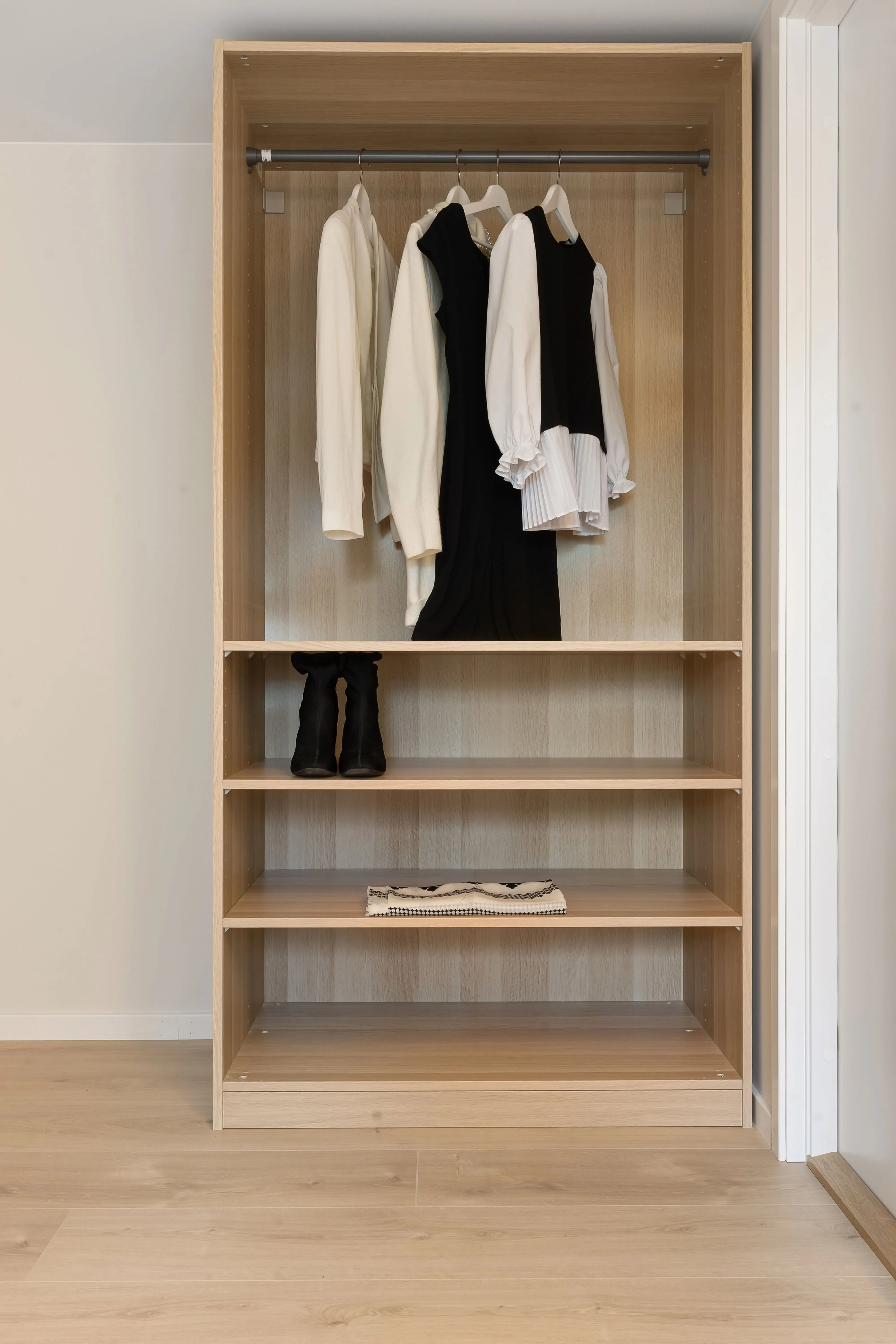
What you need
- Tape measure
- Slim velvet hangers, enough for every hanging garment
- A second rod that clips or hangs from the existing one
- Two or three bins for the shelf
- Vacuum bags or flat under-bed boxes for off-season clothes
- Bags for donations and repairs
- Masking tape and a marker for labels
- How to organize a small closet for two people: empty it out first
Remove every item and sort it into two piles by owner, on the bed rather than the floor. Reorganizing around a half-full rod hides how much is in there and turns every later decision into guesswork.
- Measure the hanging inches you actually have
Measure the usable rod length, the rod height, and the closet depth, and write the three numbers down. Rod length in inches is the figure that governs every decision after this one.
- Cull together, using one rule
Both people sit down at the same time and apply a single test: anything neither of you can recall wearing in the past twelve months leaves. Nobody rules on the other person's clothes.
- Divide the rod by frequency, not by half
Count what each person wears in a typical week, then allocate hanging inches in proportion to those counts rather than splitting the rod down the middle.
- Double the hanging space with a second rod and slim hangers
Hang a second rod from the first over the run of short garments, then swap bulky plastic hangers for slim ones. Both moves are reversible and neither requires drilling a rental wall.
- Move the seasonal load out of the closet
Send off-season clothing to under-bed storage on a twice-yearly rotation. Compression saves volume, though lofted items like down and wool do better in a loose box than a vacuum bag.
- Assign the shelf and the floor by reach
Give the high shelf to whatever gets touched monthly at most, and the floor to vertical storage in bins rather than loose piles. Reach, not seniority, decides who gets which zone.
- Agree a ten-minute reset
Set a fixed weekly slot when both people rehang, refold, and return anything that has drifted out of place. The layout only holds if the reset is scheduled rather than left to whoever notices first.
Two people, one rod, and the fight is hardly ever about clothes. It is about linear inches, and most couples have no idea how many they have.
The usual move is to draw a line down the middle on move-in day, because half each sounds fair. Then one person wears the same six things on rotation while the other folds everything they own. That middle line is the problem. How to organize a small closet for two people starts with a better cut, and fairness has nothing to do with it.
How to organize a small closet for two people: empty it out first
Everything comes out. Rod, shelf, floor, the shoebox nobody has opened since the move.
Sort by owner as you go, and do it on the bed. A bed you have to sleep in sets a deadline that a floor never will. Anything belonging to neither of you (spare bedding, cables, the router box) goes into a third pile and leaves the room.
Wipe the rod and the shelf while the space is bare. This is where most small closet organization goes wrong, because people start rearranging around the clothes they already own rather than around the box those clothes have to fit into.
Measure the hanging inches you actually have
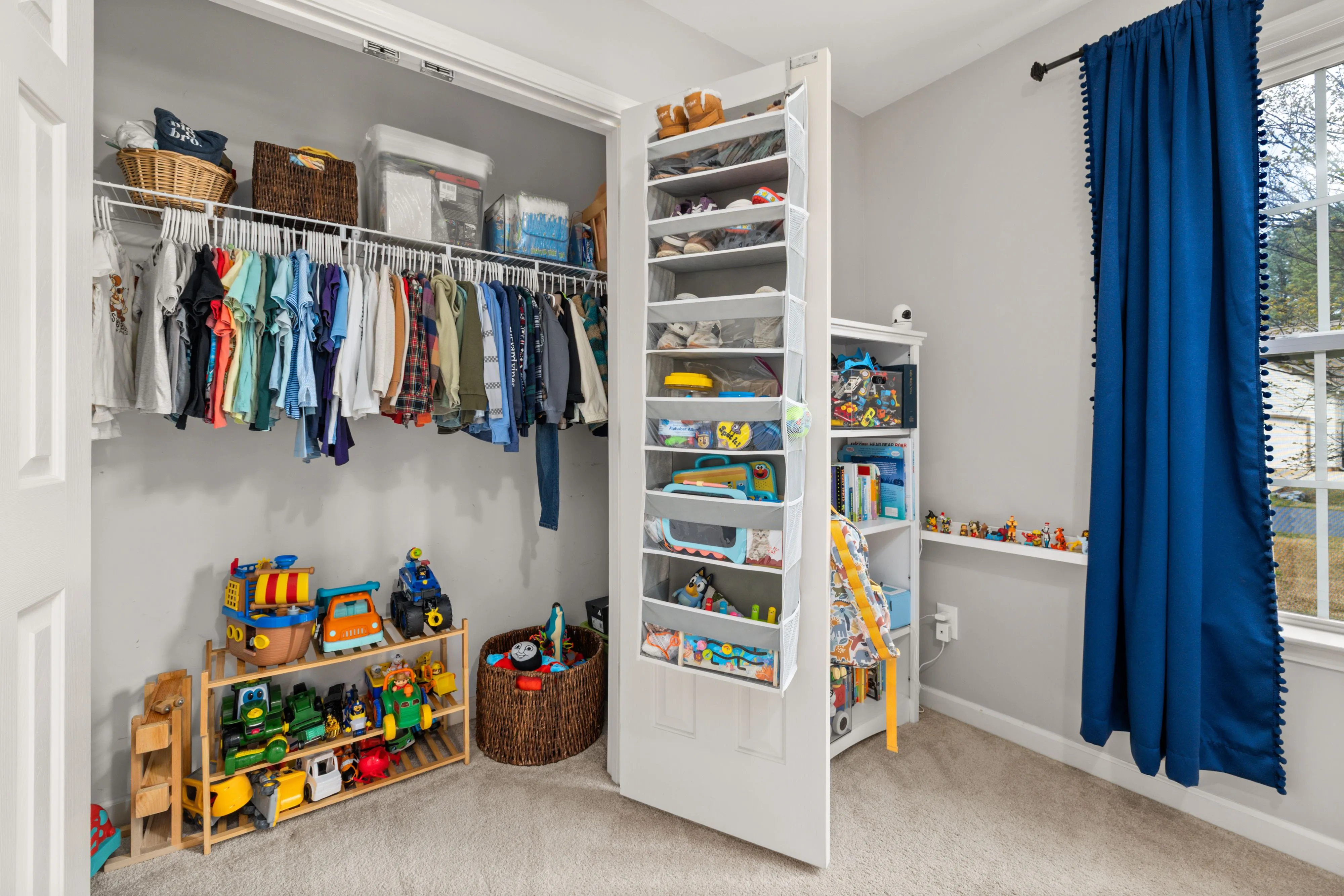
Run the tape along the rod and subtract two inches at each end, where garments bunch against the walls. What is left is your real hanging inches. Write it on the masking tape and stick it inside the door.
Then measure rod height and depth. Builders usually hang a single closet rod somewhere around 66 to 68 inches off the floor (roughly 1680 to 1730 mm), in a space about 24 inches (600 mm) deep. Those are trade conventions rather than lab findings, though they land close to what ergonomics research recommends. Work on storage accessibility puts the comfortable reach zone between about 800 and 1100 mm, notes that both reach and visibility drop off between 1400 and 1700 mm, and suggests shelf depth of no more than 600 mm at usable heights [1].
So the standard rod sits at the top edge of the awkward band, and the shelf above it sits past it. Useful to know before you decide who gets what.
Cull together, using one rule
One rule, applied by each person to their own pile: if you cannot remember the last time you wore it, it goes.
Doing this together matters more than the rule. Solo culls in a shared closet breed quiet resentment, because the person who purged watches the other person’s overflow creep across the line for the next six months.
Three bags: donate, repair, undecided. Cap the undecided bag at what one bag holds, put it on top of the wardrobe or under the bed, and open it in six months. Whatever you have not reached for by then has answered the question.
One exception worth protecting. Sentimental items are not a storage problem to be solved, and they do not belong in this test at all. Box them separately, somewhere other than the closet.
Divide the rod by frequency, not by half
Take the two piles that survived and pull out what each of you actually wears in a normal week. Work uniform, the clothes you reach for at the weekend, one thing for events.
Count the hangers in each of those weekly sets. If one set is fourteen garments and the other is twenty-six, the rod divides roughly forty to sixty, and the person with fourteen gets the drawer space instead.
This feels wrong for about a week. It stops feeling wrong the first morning nobody has to fight a compressed rod to get a shirt out.
A shared closet rewards whoever has the smaller working set, which is the practical case for a capsule wardrobe: fewer pieces that combine well take fewer inches, and the inches you free up belong to whoever needs them most. The rest of each pile, the occasional and the off-season, gets dealt with later and does not compete for prime rod space.
Double the hanging space with a second rod and slim hangers

Under a rod of shirts and jackets there is usually two and a half feet of dead air. A double hanging rod claims it. The clip-on or chain-hung kind suspends from the existing rod, needs no fixings, and comes down when you move out.
Set the upper rod for tops and the lower for trousers and skirts, and keep long coats and dresses in a separate single-hang section at one end. Two rods over the same width of wall give roughly twice the linear inches for short garments. That is arithmetic, not a research finding, so nobody is arguing about it and nobody needs a study to check. Give the lower rod to whoever is shorter, since the upper one sits well into the band where reach gets uncomfortable [1].
Hangers come next, and it pays to measure rather than trust the packaging. Hang ten shirts on the plastic hangers you already own, mark where they end, then do the same with ten slim velvet hangers. The saving comes from hanger shoulder thickness, so it scales with garment count and shows up clearly at ten. Standardising on one hanger type across both wardrobes also keeps the rod level, which is the difference between a run you can slide through and a run you have to wrestle. Research into wardrobe design points the same way, treating flexible partitioning of the interior as one of the factors that most shapes whether people find a wardrobe workable [2].
Move the seasonal load out of the closet
Half of what fills a small shared closet is not in use this month. Seasonal rotation is the cheapest square footage available to a renter, and under-bed storage is where it goes: flat boxes on castors, one per person, labelled.
Vacuum bags do compress bulky textiles dramatically. What the compression literature is more careful about is the return journey. Testing on lofted nonwoven fabrics finds that thickness does not fully recover once a compressive load comes off, leaving a residual deformation in the structure [3], and carpet studies record measurable thickness loss after sustained static loading, with how much depending on fibre type and construction [4].
Neither of those studies put a wool jumper in a bag under a bed, so treat them as a direction of travel rather than a verdict. In practice: cotton and synthetics take compression cheaply, while down coats and wool knits keep their loft better in a loose box with the lid on. Diarise the swap for early spring and early autumn so it actually happens rather than getting noticed in November.
Assign the shelf and the floor by reach
The shelf above the rod sits above the comfortable zone for most adults, and reach differences between two people in the same household can be substantial [1]. Anything you want weekly does not go up there.
Use it for bins instead of stacks: two or three labelled containers, one per person, holding hats, bags, and the overflow you agreed to keep. A bin comes down as a unit. A stack collapses on the way down.
The floor is the other reclaimable zone, and the trick is vertical storage. A narrow shoe rack, a two-drawer unit, a slim tower of shallow boxes. Loose shoes on a closet floor eat the same footprint as a rack holding four times as many, and they wander.
Leave a hand’s width of clear floor at one end. That gap is where the laundry basket, the suitcase, or the coat that came in wet goes, and having it stops the whole system from being disturbed every time something temporary shows up.
Agree a ten-minute reset
Sunday evening, ten minutes, both of you.
Rehang what has ended up on the chair. Return anything that migrated into the other person’s inches. Put the two or three items quietly on their way out into the donate bag rather than back on the rod.
The reason to schedule this rather than trust goodwill is that shared closets fail asymmetrically. One person notices the drift first, tidies alone, and starts keeping score. Ten minutes on a fixed slot costs less than that conversation.
Every few months, recount the weekly sets from step four. Jobs change, seasons change, and the frequency split that was right in March may not be right in October. Adjusting the division of hanging inches is a five-minute job when the system is already in place.
If it is still tight after all of that, the answer is not a cleverer closet. It is moving categories out of it.
Folded knitwear belongs in a dresser, not on hangers, where it stretches at the shoulders anyway. Gym clothes and socks can live in a bedside drawer. Bags and coats can go on hooks behind the bedroom door. Suitcases go on top of the wardrobe or under the bed, never inside. Shoes worn daily can sit by the front door instead of in the bedroom at all.
Strip those out and a narrow rental closet is left doing the one job it is shaped for, which is hanging the clothes two people wear this month.
The number to keep is the one on the masking tape inside the door. Next time either of you is holding something in a shop, that figure is the honest question: which of the inches already spoken for does this replace?
References
- (2015). Ergonomic suitability of kitchen furniture regarding height accessibility. Collegium Antropologicum. https://hrcak.srce.hr/file/217259
- (2025). Demystifying user needs in wardrobe furniture design: A network analysis via text mining and DEMATEL-ANP integration. BioResources. https://bioresources.cnr.ncsu.edu/resources/demystifying-user-needs-in-wardrobe-furniture-design-a-network-analysis-via-text-mining-and-dematel-anp-integration
- (2022). Comparative study on compressional recovery performance of vertically laid and cross-laid highloft nonwovens. Journal of Industrial Textiles. https://doi.org/10.1177/1528083720925828
- (2022). Effects of filament fineness and disc type of drawn textured polyester yarns on carpet resilience and appearance retention performance. Journal of Industrial Textiles. https://doi.org/10.1177/15280837221130516
The fire's still going.
Stoke another read →